
Teaching AI, and Building It Into the Lesson: Two Learning Implementations at COMET
Over the past year, COMET instructional designers have been working on a question facing a growing number of scientists and educators: how do we use AI well? Not how do we use it more, or faster, but how do we use it in ways that can help people become more capable? Two efforts have taken shape around that question. One teaches people to work with AI. The other builds AI directly into the learning experience itself.
Hands-on workshops: AI fluency with judgment
The first effort is a series of hands-on workshops designed and facilitated for university faculty, students, post-docs, and working professionals, in groups of 15 to 30 participants. COMET has run eight sessions so far, reaching well over a hundred professionals. The most recent was a two-hour synchronous workshop for roughly 30 UCAR interns from across the organization.
The sessions share a common design. They are practical, exercise-driven, and grounded in learning science, while adapting to the specific needs of each audience. For scientists, the focus is the research workflow: accelerating literature reviews, sharpening research proposals, adapting technical material for different readers, and working through data analysis and visualization with a sample dataset. For instructional designers, the same tools become a design apprentice that can assist with drafting learning objectives, activities, content, and assessment questions. In this way, participants experience the time-saving benefits of these tools while also developing a working appreciation for how carefully the instructional integrity of AI-generated material must be protected.
What unites the workshops is a deliberate refusal to treat AI as a way to bypass thinking. They draw on learning science to distinguish genuine learning from the mere feeling of it, and to help participants recognize when AI use is appropriate and when it is not. Reducing confabulations (commonly referred to as “hallucinations”), the confident fabrication that remains these tools' most persistent failure mode, is a recurring theme, particularly in literature reviews and technical writing. To learn how to overcome this issue, participants spend substantial time developing prompting strategies that yield reliable, verifiable results, working with tools including ChatGPT, Gemini, NotebookLM, and Claude. Across every audience, the aim is consistent: enough fluency to capture the efficiency these tools offer, and enough critical judgment never to trust their output blindly.
An AI coach, not a substitute
Where the workshops teach people how to use AI as an effective and efficient tool, a second effort builds it into the lesson itself. EUMETCAL's Leveraging MTG Satellite Data for Fire Weather Decision-Making and From Echoes to Decisions: Analyzing Radar for Summertime Convective Storms self-paced modules, developed in collaboration with COMET, feature a custom AI coach designed to function less like an answer key and more like a mentor.
The interaction is simple from the learner's side. They submit an analysis in their own words, for example, interpreting a fire-weather situation or a radar signature, and the AI coach evaluates the response against a rubric. But rather than marking it correct or incorrect, the coach first affirms what the learner did well, then poses guiding questions that prompt them toward their own next step instead of supplying the answer outright. When a learner struggles repeatedly, the coach adjusts, tailoring its feedback to the areas where they have had the most difficulty.
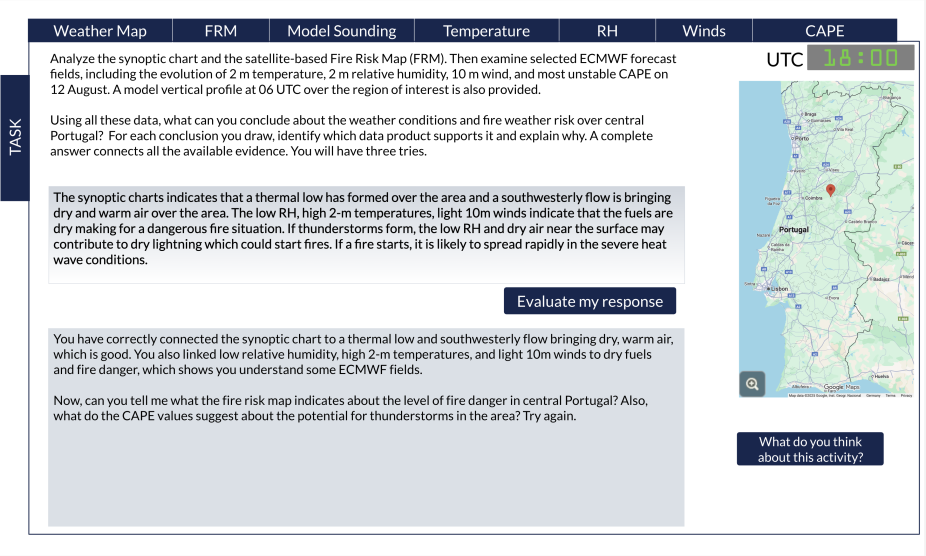
The AI coach evaluates a learner's response, highlights what the learner got right, then poses guiding questions designed to help the learner think critically about their response and refine their answer.
Under the hood, the coach connects Articulate Storyline SCORM modules to a large language model through a serverless AWS architecture, developed iteratively: an initial prototype tested with subject-matter experts, refined through analysis of learner responses, and hardened through security review before handoff for deployment. The modules were published in July of this year.
The design intent mirrors the workshops exactly. The same learning-science principles taught in the workshop, including productive struggle, reflection, and feedback that meets each learner where they are, are embedded in the structure of the course itself. The coach is deliberately constrained: it will not hand over the analysis, because the analysis is the learning.
Learn more about the EMETCAL modules in this short video.
The common thread
Both projects rest on the same conviction: the measure of AI in education is not engagement, speed, or volume of content, but whether learners come out the other side more capable than they went in. Sometimes that means teaching a scientist to interrogate a model's confident answer. Sometimes it means building a coach that refuses to give one. In both cases, the technology is in service of the same old, challenging, and worthwhile goal: learning that sticks and is used to solve life’s problems.
Did you know?
COMET is best known for our learning platform, MetEd, but we also work with our partners to develop learning content for their own platforms. If you're interested in the MTG fire-weather and radar modules described in this article, they'll be released on EUMETCAL's learning platform. For questions about the AI workshop series, contact the COMET Program.